
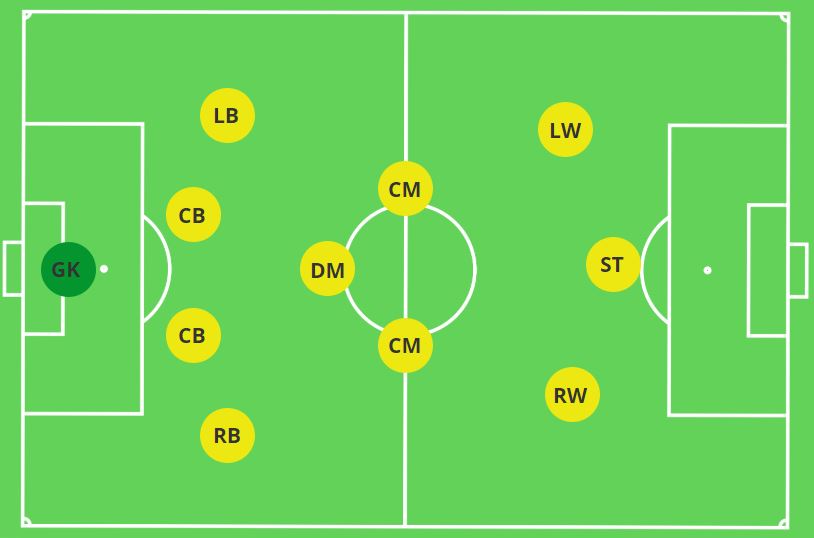
If you look at the teams actually lifting the European Cup lately, a massive trend hits you right in the face. Lining up in a 4-3-3 formation isn’t just a tactical choice anymore; it’s basically the entry fee for Champions League winners. I’ve watched enough elite football to spot the blueprint. Whether it was the dizzying possession carousels we witnessed at Camp Nou or the heavy-metal press that turned Anfield into a fortress, the underlying tactics always strip back to this exact same shape. So what is it about this specific setup that just naturally tears other teams apart?
The terrace talk usually focuses on the flashy forwards, but the actual cheat code here is geometry. It’s a framework that chokes the life out of the opposition while keeping the back door firmly shut.
The Total Football DNA
You can trace this blueprint straight back to the 1970s. When Johan Cruyff was tearing it up with Ajax and the Netherlands, he hardwired “Total Football” into the sport. That style demands relentless movement, supreme positional awareness, and natural angles. The 4-3-3 was his absolute perfect answer.
Think about the rigid, flat 4-4-2 setups we grew up watching in the 90s. The 4-3-3 completely bypasses that stiffness because it inherently generates passing triangles in every single phase of play. It doesn’t matter if the center-back is stepping out with the ball, the holding midfielder is trapped under a high press, or the left-winger is isolated on the flank—the man in possession instantly has two natural outlets. That is the absolute bedrock of elite possession football.
Balance Analysis: The Engine Room and the Trident
When we conduct a proper balance analysis of the 4-3-3, the brilliance of the midfield trio becomes the focal point. This is where games are won and lost.
The Midfield Triangle
Usually set up with a single defensive pivot (a traditional #6) and two box-to-box or advanced playmakers (#8s), the midfield commands the center of the park.
- The Anchor: The #6 sits just ahead of the center-backs, breaking up counter-attacks and acting as the metronome for distribution. Think Rodri at the Etihad or prime Sergio Busquets.
- The Twin Eights: These players operate in the “half-spaces” (the channels between the wing and the center), pulling opposition defenders out of position and feeding the frontline.
The Attacking Trident
When looking at elite attacking formations, the 4-3-3’s front line is a nightmare to defend against. The modern winger is rarely a traditional touchline-hugging crosser anymore. Instead, we see inverted wingers. Take “The Egyptian King” Mohamed Salah. Starting on the right flank, he cuts inside onto his lethal left foot, completely skipping traditional fullbacks and attacking the spaces between the center-back and the wide defender.
This movement is often complemented by a “False Nine”—a striker who drops deep into midfield, dragging a center-back with him and opening up massive gaps for those inverted wingers to exploit.
A Universal Setup: Why It’s the Manager’s Favorite
The true beauty of the 4-3-3 is that it isn’t a rigid doctrine; it’s a remarkably flexible foundation. It is a true universal setup, which is exactly why coaches worldwide share adaptations customized to their specific personnel.
Just look at the contrast between two of the Premier League’s greatest modern iterations:
- Guardiola’s Positional Play: Pep uses the 4-3-3 to dominate the ball. His fullbacks often invert into midfield to create numerical superiority, allowing the #8s to push high up the pitch almost as secondary strikers.
- Klopp’s Heavy Metal Football: Jurgen Klopp used the exact same base shape at Liverpool, but turned it into a high-octane pressing machine. His 4-3-3 relied heavily on overlapping, attacking fullbacks (Trent Alexander-Arnold and Andy Robertson) providing the width, while the midfield trio acted as a tireless, hard-tackling shield.
Both are 4-3-3 on paper. Both are entirely different beasts on the grass.
Why the 4-3-3 Crushes the Competition
If you are wondering why your favorite team probably lines up this way on a Saturday afternoon, here is the quick tactical rundown:
- Numerical Superiority in Midfield: Against a 4-4-2, a three-man midfield always has an extra man. This allows a team to dictate the tempo and control possession effortlessly.
- High Pressing Efficiency: The front three are perfectly positioned to press the opponent’s backline. The striker presses the center-backs, while the wingers lock down the fullbacks, forcing high turnovers.
- Width and Depth: With wingers pinning the opposition’s defense back and fullbacks overlapping, the team stretches the pitch both horizontally and vertically.
You don’t need a UEFA Pro License to see how the game has shifted over the last twenty years. Deploying a 4-3-3 isn’t some maverick, attacking gamble anymore. It’s just the bare minimum required to compete at the top level. Half the time you watch a team painfully park the bus on a Sunday afternoon, they’re literally just trying to survive the sheer number of angles this shape dictates. Unless a manager suddenly figures out a completely bizarre new way to cover grass and disrupt those natural passing lanes, this setup will keep bullying everyone else on the pitch.