
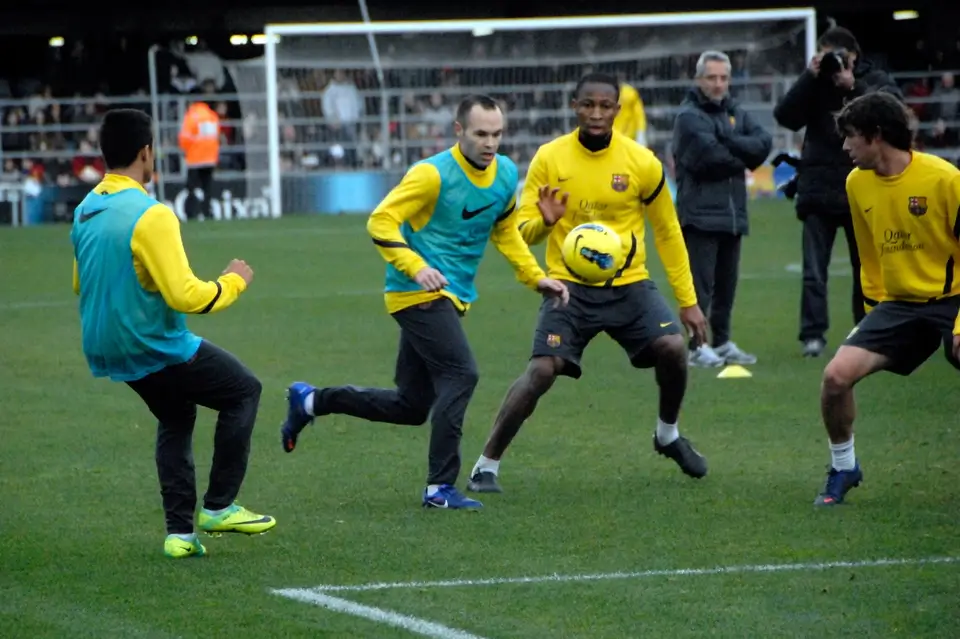
If you watched European football between 2008 and 2015, you didn’t just watch a sport; you witnessed an artistic revolution. Sitting right at the center of the Camp Nou pitch were two diminutive geniuses who completely broke the sport and rewired how we understand possession. The Xavi vs Iniesta debate has fueled countless late-night Reddit threads, Twitter wars, and pub arguments. Both are untouchable legends, but when forced to pick, who actually comes out on top?
TL;DR: If you want a quick answer to settle your group chat debate, here it is: Xavi Hernández was the system itself, the metronome who provided total control and dictated the tempo. Andrés Iniesta was the magic, the line-breaker who thrived in chaos and delivered in clutch moments. You can’t have the ultimate tiki-taka duo without both, but tactically, Xavi was the irreplaceable brain of Pep Guardiola’s machine, while Iniesta was the unstoppable heartbeat.
Now, let’s break down exactly why.
You have one game to save your life against a prime Jose Mourinho parked bus. You can only pick ONE to unlock the defense. Who are you giving the #8 shirt to? 🧠🪄
The Core of the Debate: Xavi vs Iniesta
To understand them, we have to separate their roles. Because they wore the same colors, came through La Masia, and won the exact same international trophies with La Roja, casual fans often blur them into one entity. But on the pitch, their tactical responsibilities were distinct.
Xavi Hernández: La Computadora
I vividly remember watching the 2011 Champions League Final at Wembley. Manchester United’s midfield was chasing shadows, completely gassed by the 60th minute. The reason? Xavi.
Xavi was obsessed with space and possession. His signature move, la pelopina (that tight 360-degree turn to shield the ball), allowed him to scan the entire pitch while under immense pressure. He didn’t do stepovers; he didn’t need to. His genius was entirely cognitive.
When we look at historical data from FBref or Opta, Xavi’s numbers are absurd. We are talking about a player who routinely hit over 100 passes a game with a pass accuracy constantly hovering around 93% to 95%. But it wasn’t sideways passing. Xavi led Europe in progressive passes and passes into the final third. He decided whether the team would breathe and recycle possession, or plunge the dagger into the opposition’s backline.
Andrés Iniesta: The Illusionist
If Xavi was the conductor of the orchestra, “Don Andrés” was the electric guitar solo. Iniesta operated slightly higher up the pitch, largely dominating the left half-space.
Where Xavi passed to beat a man, Iniesta carried the ball. His center of gravity, ball retention, and croqueta (shifting the ball rapidly from one foot to the other) made him statistically one of the greatest dribblers of his generation. Iniesta’s job was to receive the ball on the half-turn, attract two or three defenders, and slip out of the trap, completely destroying the opponent’s defensive structure.
Breaking Down the Stats: Pass Accuracy and Beyond
You can’t compare these two without looking at the underlying numbers. While stats alone don’t capture the sheer panic they induced in defenders, a side-by-side look at their Barcelona careers highlights their different tactical impacts.
| Statistic (FC Barcelona Career) | Xavi Hernández | Andrés Iniesta |
| Total Appearances | 767 | 674 |
| Total Goals | 85 | 57 |
| Total Assists | 185 | 136 |
| Peak Pass Accuracy | ~93-95% | ~88-90% |
| Primary Tactical Role | Deep-Lying Playmaker (Metronome) | Advanced Playmaker (Line-Breaker) |
- Pass Accuracy: Xavi undeniably takes the crown here. Over his prime La Liga and Champions League seasons, Xavi’s completion rate rarely dipped below 92%. Iniesta was heavily involved, usually operating around 88-90%. Why the slight drop? Iniesta was tasked with taking more risks in tighter, more congested areas near the penalty box.
- Assists and Goal Creation: Over their Barcelona careers, Xavi racked up roughly 184 assists across all competitions, while Iniesta registered around 138 (per Transfermarkt). Xavi’s set-piece delivery and deeper playmaking edge him ahead in pure creation volume.
- Progressive Carries: This is where Iniesta shines. His ability to carry the ball 15-20 yards through a low block was unmatched. He bypassed midfielders with footwork rather than passing.
Are You a True Culer?
The Ultimate Tiki-Taka Duo: How They Complemented Each Other
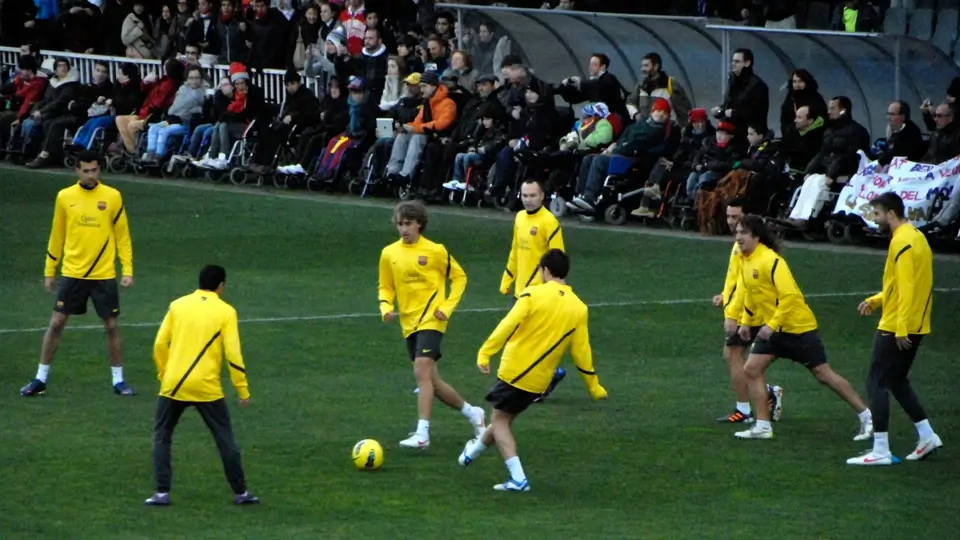
The terrace talk often ignores that they needed each other to achieve perfection. Alongside Sergio Busquets—the undisputed anchor who did the dirty work — they formed a midfield triangle that literally passed teams into submission.
Here is why they functioned so perfectly as the ultimate tiki-taka duo:
- Gravity and Space: Iniesta drew defenders toward him through dribbling, which naturally opened up passing lanes for Xavi to exploit.
- Tempo Variation: Xavi maintained the “pausa” (the deliberate slowing down of play to freeze defenders), while Iniesta provided the sudden, violent acceleration of play.
- Positional Fluidity: If Xavi dropped deep alongside the center-backs to build up play, Iniesta drifted wide or pushed up to link with Lionel Messi, ensuring Barcelona always had numerical superiority in midfield.
Big Game Impact: Who Delivered When It Mattered Most?
This is where the debate gets incredibly spicy.
Xavi was the MVP of Euro 2008 and provided four assists in the 2009 calendar year where Barcelona won the sextuple. He also casually dropped two assists in the 2009 Champions League Final against Manchester United. Xavi gave you a 9/10 performance every single week, establishing a baseline of utter dominance.
However, Iniesta is responsible for the two most iconic goals in modern Spanish football history. You cannot ignore the human element of clutch factor.
- Stamford Bridge, 2009: The 93rd-minute outside-of-the-boot screamer against Chelsea that sent Barcelona to the UCL Final.
- Soccer City, 2010: The 116th-minute volley against the Netherlands that won Spain their first-ever World Cup.
Iniesta had a bizarre habit of not scoring many goals, but saving the ones he did score for the biggest moments in human history.
The Verdict
If you are building a team from scratch and need an architect to define your entire style of play, you draft Xavi Hernández. He is the greatest tempo-setter the game has ever seen.
But if you already have a functioning team and need that spark of individual genius to unlock a stubbornly parked bus or win you a World Cup final in extra time, you hand the number 8 shirt to Andrés Iniesta.
They were two halves of the same brilliant brain. We will never see a partnership like it again.
Frequently Asked Questions
Who won more trophies, Xavi or Iniesta? Andrés Iniesta has a slight edge in total career trophies. While both won absolutely everything together at Barcelona and with the Spanish national team (including the World Cup and two Euros), Iniesta’s extended domestic success with Barça after Xavi left in 2015, plus his trophies in Japan with Vissel Kobe, puts him slightly ahead in overall silverware.
Who finished higher in the Ballon d’Or rankings? Both players, unfortunately, peaked during the Lionel Messi and Cristiano Ronaldo duopoly. However, Iniesta finished 2nd in 2010 (with Xavi 3rd) and 3rd in 2012. Xavi finished 3rd three consecutive times (2009, 2010, 2011). Neither won it, which remains one of football’s greatest crimes.
Could they play effectively without each other? Yes. While they were better together, Xavi dictated games for Spain long before Iniesta became a regular starter (most notably leading Spain to Euro 2008 glory). Conversely, after Xavi left Barcelona in 2015, Iniesta continued to play at a world-class level, winning domestic doubles and providing masterful performances under Luis Enrique.
Who defended better, Xavi or Iniesta? Iniesta, if we’re talking about actual running and tackling. He’d track back 40 yards, harass a full-back, and win the ball clean. Xavi rarely did that — he just made sure the ball never needed winning back in the first place, because he never lost it. Different jobs, same result: neither midfield ever looked exposed.
Which one fits today’s pressing-obsessed football better? Xavi, easily, if you’re building a system. Every top coach right now wants a player who can receive under pressure and immediately solve it — that’s basically his whole career in one sentence. Iniesta doesn’t fit a system so much as he breaks one. Against a low block that’s suffocating everyone else, he’s still the guy finding a gap that supposedly doesn’t exist.
Who was more clutch in the biggest moments? Iniesta, if we’re honest. Stamford Bridge in 2009, the World Cup final in 2010 — you don’t forget goals like that, ever. Xavi never had that one iconic strike everyone replays, but watch him in a tense final, and he’s still asking for the ball on minute 89 when guys twice as “brave” are hiding from it. So maybe clutch isn’t one thing. Iniesta gave you the moment. Xavi made sure there was still a game left to have one in.
If you’re building a midfield from scratch, who do you start with? It depends on what kind of team you’re trying to build. Xavi first, if you want control — everything orbits around his rhythm, and the team basically never panics. Iniesta first, if you want unpredictability — give him space near the box and trust that something ridiculous is coming. Most fans will tell you which one they’d pick before you even finish the question, and that’s kind of the point.