
Let’s be honest – we all miss the nostalgia of 2000s football. The baggy shirts, the Total 90 boots, and legends like Zidane and Ronaldinho in their prime. But you know what we don’t miss? The absolute refereeing howlers that decided the fate of nations.
Today, we complain when VAR takes three minutes to check an offside by a toenail. But back then, you could score a clear goal, celebrate it, and have it ruled out because the linesman blinked.
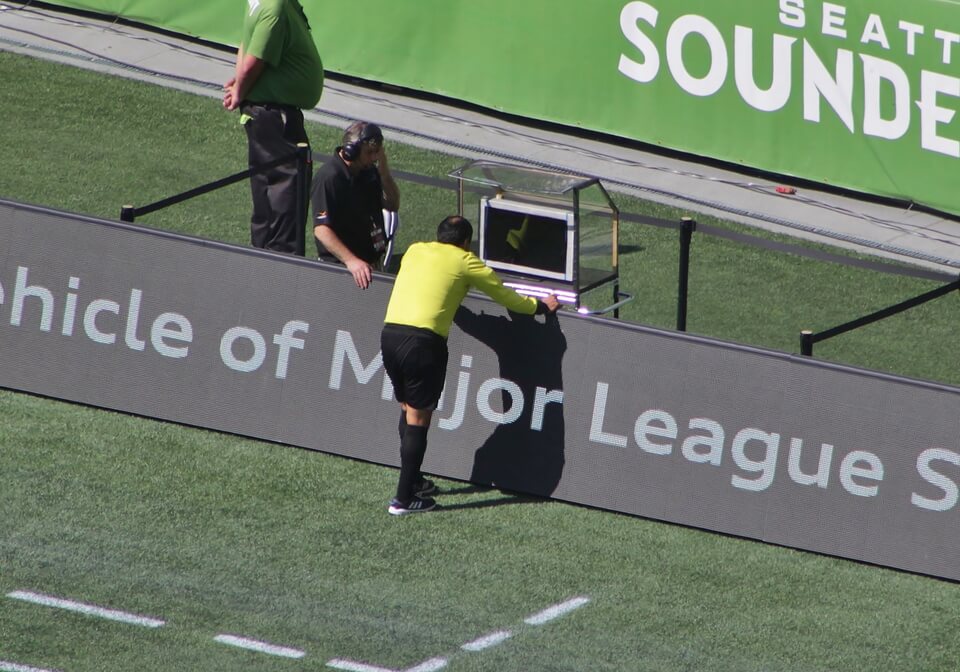
Let’s fire up our imaginary time machine, install a VAR monitor on the sideline, and see how the history of the beautiful game would have changed.
2002: The Great Robbery in the East
The 2002 World Cup in South Korea and Japan was magical for the underdogs, but for Italy and Spain, it remains a nightmare fueled by questionable officiating.
Round of 16: South Korea vs. Italy (2-1)
The Villain: Referee Byron Moreno.
The Azzurri were packed with legends like Maldini, Vieri, and Totti. They faced the hosts, South Korea.
- The Incident: In extra time, Francesco Totti went down in the box under pressure. Instead of a penalty or a “play on,” Moreno showed Totti a second yellow card for diving. Italy went down to 10 men. Later, Damiano Tommasi scored a Golden Goal that was wrongly flagged for offside.
- VAR Verdict:
- Totti: Replays show contact. It might have been a “soft” penalty, but it was 100% not a dive. VAR advises the ref to rescind the yellow card. Italy keeps 11 men.
- Tommasi: VAR lines show Tommasi was onside. Goal stands.
- The Outcome: Italy wins via Golden Goal. The conspiracy theories regarding Byron Moreno never existed.
Quarter-Final: South Korea vs. Spain (0-0, 5-3 pens)
The Villain: Referee Gamal Al-Ghandour and his linesmen.
If you thought Italy got robbed, Bg look at Spain. They had two perfectly legal goals disallowed.
- The Incident: Joaquin drove down the flank and crossed for Morientes to head home. The linesman raised his flag, claiming the ball had crossed the goal line before the cross.
- VAR Verdict: High-definition slow-mo shows the ball was still on the line. Physics doesn’t lie.
- The Outcome: Morientes’ goal stands. Spain wins 1-0 in normal time and advances to the semi-finals to face Germany.
Alternate History: A Germany vs. Spain final in 2002? It’s very likely.
2006: The Dive That Built an Empire
Italy eventually won the 2006 World Cup, wiping away the tears of 2002. But they probably shouldn’t have made it past the Round of 16.
Round of 16: Italy vs. Australia (1-0)
The Villain: A split-second decision.
Australia, led by Guus Hiddink, was incredible. They held 10-man Italy to a 0-0 draw and looked dangerous heading into extra time.
- The Incident: 95th minute. Fabio Grosso cuts into the box, cuts inside Lucas Neill (who is sliding on the ground), and trips over the defender’s torso. Penalty given. Totti scores. Game over.
- VAR Verdict: The replay is damning. Neill was already on the ground and made no movement to trip Grosso. Grosso dragged his left leg to initiate contact. It’s a simulation.
- The Outcome: No penalty. Grosso gets a yellow card. The game goes to extra time with Italy exhausted and down a man (Materazzi was sent off earlier).
- The Butterfly Effect: If Australia wins in extra time, Italy goes home. No Zidane headbutt in the final (because Italy isn’t there). Did France win the 2006 World Cup easily against Australia or Ukraine? Probably.
2010: The Goal That Forced Change
This was the moment that finally broke FIFA’s resistance to technology.
Round of 16: Germany vs. England (4-1)
The Villain: Referee Jorge Larrionda.
Germany was leading 2-1, but England had all the momentum.
- The Incident: Frank Lampard chipped Manuel Neuer from the edge of the box. The ball hit the crossbar, bounced clearly over the line (by half a meter!), and spun back out. The ref waved “play on.”
- VAR Verdict: You wouldn’t even need VAR; the vibrating watch of Goal-Line Technology would scream GOAL.
- The Outcome: It’s 2-2 at halftime.
- The Butterfly Effect: Instead of chasing the game and getting picked apart by German counter-attacks (Müller was lethal that day), England could play conservatively. We might not have seen a 4-1 thrashing. Germany might still have won, but the “Golden Generation” of England wouldn’t have been humiliated.
Bonus: The Worst Acting Performance (2002)
Brazil vs. Turkey (Group Stage)
- The Incident: Turkey’s Hakan Ünsal kicked the ball at Rivaldo, who was waiting to take a corner. The ball hit Rivaldo’s thigh. Rivaldo collapsed, clutching his face like he’d been shot. Ünsal got a Red Card.
- VAR Verdict: The ref checks the monitor, sees the ball hit the leg, and sees Rivaldo’s Oscar-worthy acting.
- The Outcome: Ünsal gets a Yellow (for unsportsmanlike conduct). Rivaldo gets a Yellow for simulation. Justice served.
Conclusion: The Alternate History of Champions
If technology had arrived a decade earlier, the history books would look very different:
- Spain might have won their first World Cup in 2002, not 2010.
- France (and Zidane) likely would have retired as two-time World Champions in 2006.
- South Korea’s historic 4th place finish would likely remain a “What if?”
- Frank Lampard would have one more World Cup goal to his name.
Football is beautiful because of its imperfections, but looking back at these clips, it’s hard not to feel a little bit of anger for the teams that were sent home by a whistle, rather than a goal.